
Introduction
The universal rule of aging
Aging. It is everywhere. For a while, I went so far to say “Everyting ages.”. And it, meaning the gradual decay that accompanies us along every step from birth to the final hours, does feel like a universal rule.
Everywhere we look, we see it. People grow old [§ Dönertas 2026]. Dogs become slower. Trees lose branches. Buildings crumble. Materials lose their edge. Machines give in. Even stars are born, evolve and change over billions of years, until they eventually exhaust their fuel and reach the end of their stellar lives in one way or another.
Because of this natural occurrence, we rarely question aging. There seems to be a general acceptance when it comes to it as if it is one of the foundations of life, like the second law of thermodynamics.
And perhaps that is exactly why we tend to accept aging so readily. If everything ages, why should we be any different?
You live and eventually you age…and you die; hopefully later rather than sooner.
But accepting aging as inevitable makes it easy to overlook what aging actually is.
I already mentioned the “gradual decline” that is the key aspect of aging and affects everything. Just looking at humans, aging:
- makes us more susceptible to diseases, sometimes even causes them (looking at you cancer!) [§ Neustadt 2008, § Paneni 2017, § Rodgers 2019, § Montegut 2024],
- makes us smaller, wrinkly AND bald [§ Hamilton 1951, § Ryall 2008, § Thurstan 2012, § Vary 2015],
- increases our vulnerability to depression and a tendency for a bleaker outlook on life [§ Gareri 2002, § Aziz 2013],
- takes our strength by reducing the very muscles that keep us up and moving [§ Ryall 2008, § Pathai 2013],
- and causes pain when we move [§ Thomas 2014],
- worsens our ability to see and hear [§ Truscott 2009, § Pathai 2013, § National Eye Institute 2025],
- can reduce our libido and fertility [§ Schiavi 1995, § Meston 1997],
- takes away our minds [§ Larson 2013],
- makes organisms die more easily in general [§ Horiuchi 1997],
- and by all this together, it takes the joy out of life.
Aging takes away the joy of life
Put all of this together and aging doesn’t sound particularly pleasant. Yet if it truly is a universal and unavoidable consequence of life, there wouldn’t seem to be much point complaining about it.
Except there is a problem with that assumption.
A Conundrum
When scientists scratched a little deeper they uncovered a rather interesting phenomenon.
Aging, as it turns out, isn’t just aging.
A mayfly gets days. We get decades. A Greenland shark gets centuries. And some organisms seem remarkably good at escaping many of the consequences of aging altogether, exhibiting negligible senescence and showing little or no measurable decline in biological function despite the passage of a frickton of time. [§ Pearl 1928, § Hulbert 2007, § Rubner 2008, § Healy 2014]
And even among the same species there happen to be large differences between individuals. Some dogs live 15 years while others die at 8. Humans reach their 120th birthday fine and smiling while others succumb to the claws of age at 50! Even the symptoms of aging aren’t the same. [§ Rubel 2013]
It appears that…
All organisms age, but some age more equally than others.
Why? What determines whether an organism deteriorates after a few years or remains functional for centuries?
To answer that, we first need to understand what aging actually is.
The components of aging
Component Nr. 1: Damage
Every second of every day, our bodies are damaged.
Some damage comes from the outside.
- Ultraviolet radiation from sunlight [§ Thurstan 2012]
- X-rays [§ Bertell 1977]
- Environmental toxins [§ Migliore 2009, § Vriens 2019]
- Infections [§ Gavazzi 2002, § Finch 2010]
- Mechanical wear [§ Aigner 2004]
Other damage is an unavoidable consequence of being alive.
- DNA replication mistakes [§ Burhans 2007, Herr 2024]
- Reactive oxygen species produced during metabolism [§ Liguori 2018]
- Protein misfolding [§ Cuanalo-Contreras 2013]
- Cellular waste products [§ Terman 2006, § Terman 2007]
- Random molecular errors
Damage is therefore not unusual. It is one of the occupational hazards of being alive.
But if we are being damaged constantly, why aren’t children already falling apart? Why don’t they show the same deterioration we associate with old age? Because damage is only half of the story. The other half is repair.
Component Nr. 2: Repair
Fortunately, our bodies are also remarkably good at dealing with damage.
From the body, its organs, and all the way down to its cells, there are thousands of maintenance mechanisms hard at work that
- repair DNA [§ Sancar 1995],
- replace damaged proteins [§ Visick 1995, § Goldberg 2003],
- recycle cellular waste [§ Settembre 2013],
- eliminate malfunctioning cells [§ Poon 2014],
- regenerate tissues [§ Baddour 2012], and
- compensate for lost function [§ Jones 2017].
Life as we know it could only evolve to its current state because these maintenance systems constantly fight against damage. And while we are young, they are remarkably effective.
The problem is that maintenance is not perfect. Some damage remains. Worse, the machinery responsible for maintenance is itself made of DNA, proteins and cells and can therefore become damaged as well [§ Rattan 2006].
- DNA repair becomes less effective.
- Stem cells become exhausted.
- Damaged proteins accumulate.
- Cells stop dividing or function less efficiently.
- Over time, the machinery responsible for keeping us healthy slowly loses performance, while impaired repair allows still more damage to accumulate.
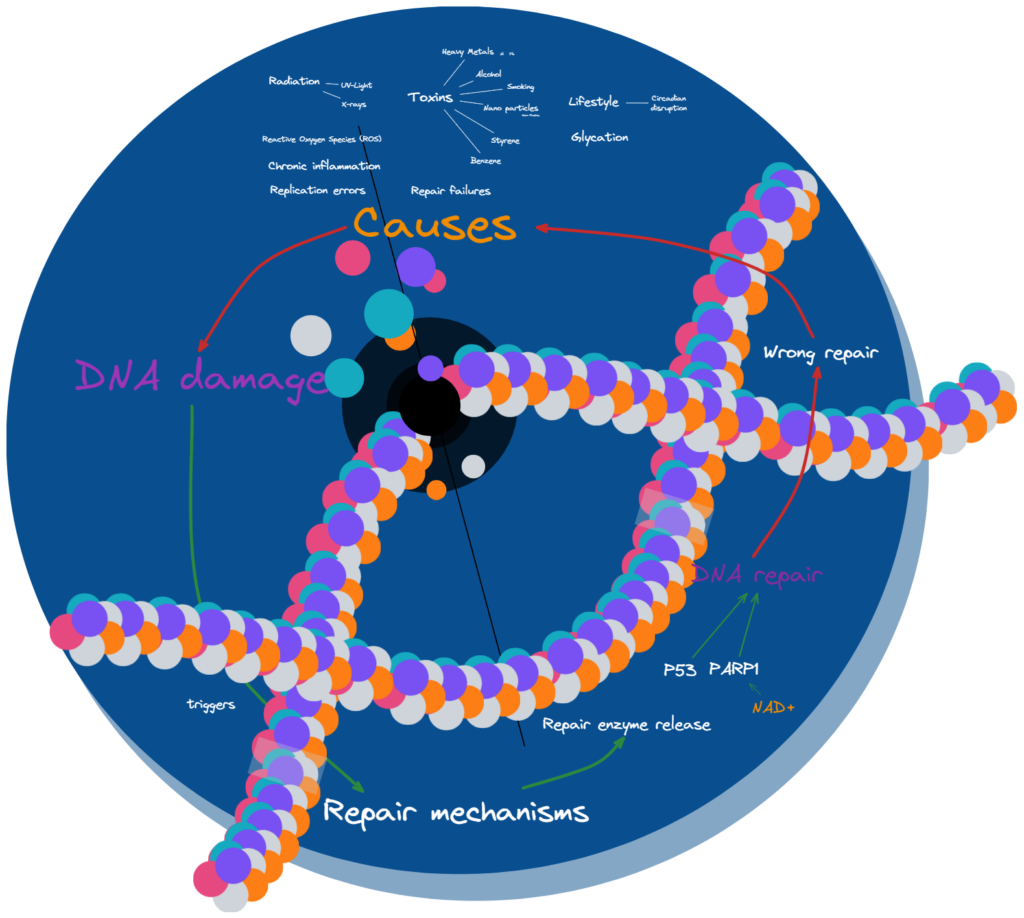
The sum of both. Aging.
Damage is constantly being generated, maintenance is constantly trying to undo it, the difference, and what matters in this case, is what remains. Net damage, or aging.
We can reduce the whole process to a simple equation:
Net damage = damage generated − damage repaired
If maintenance could perfectly compensate for damage forever, there would be no net damage to accumulate. But it can’t. And over days, years and decades, what remains adds up.
That progressive accumulation of net damage is at the heart of aging.
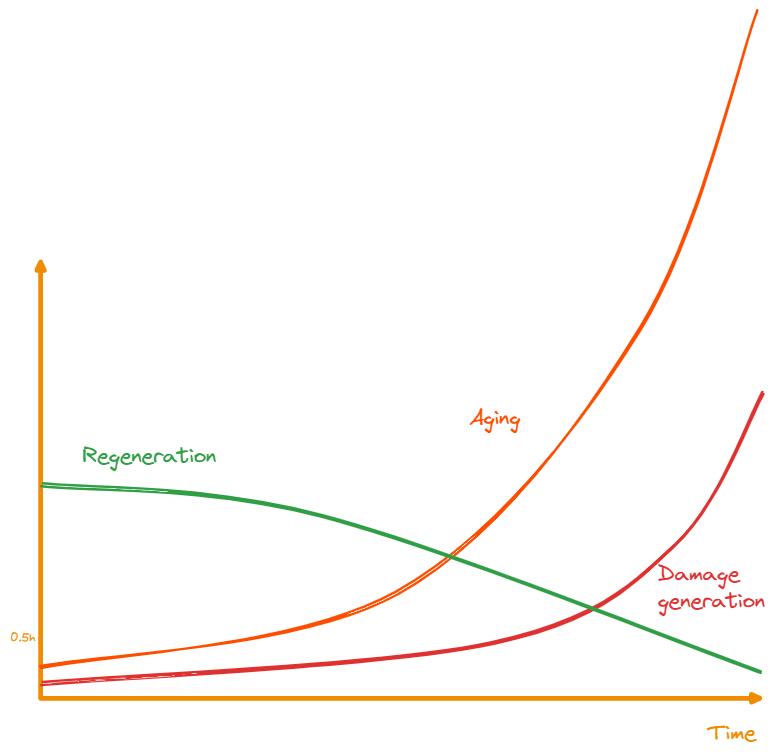
As long as our maintenance systems keep up, typically while we are young, little net damage accumulates. But whenever they don’t, some damage remains. Small differences compounded over years and decades eventually become substantial.
Aging is the progressive accumulation of net damage when damage generation increasingly exceeds the body’s ability to repair, renew, and compensate.
The actual biology is, of course, considerably more complicated. Aging involves interconnected processes ranging from genomic instability and epigenetic changes to mitochondrial dysfunction, cellular senescence and stem-cell exhaustion. These are summarized as the Hallmarks of Aging. But underneath that complexity lies a surprisingly simple idea:
Life is a continuous battle between damage and maintenance. Aging is what happens when maintenance can no longer keep up.
So we don’t age simply because another birthday passes. We age because damage continuously occurs throughout our bodies, while the systems responsible for repairing, replacing and compensating for that damage cannot keep up forever.
What remains accumulates.
And eventually we see the consequences: wrinkles and gray hair, yes, but also weaker muscles, failing senses, declining resilience and a rapidly increasing risk of diseases that can ultimately kill us.
And it is also why we observe such differences in aging across species and individuals.
If aging depends on both how much damage occurs and how effectively that damage is dealt with, then different rates of aging are exactly what we should expect.
An organism’s environment, metabolism and behavior influence the damage it experiences. At the same time, evolution has equipped different species with very different abilities to prevent, repair, remove and compensate for that damage.
Some species can even regenerate structures that humans permanently lose. Certain fish and birds, for example, can replace damaged sensory hair cells in the inner ear, whereas humans cannot [§ Rubel 2013].
But that also begs the question, if species can influence the seemingly primordial equation of damage and repair in their favor, is aging really inevitable?
The disease of age
This is also why many gerontologists argue that aging should be considered a disease; and in fact a very potent one [§ Bulterijs 2015, § Khaltourina 2020, § Dattani 2023].
Aging progressively impairs the systems that keep us healthy. It reduces our resilience, increases our susceptibility to disease and is the greatest risk factor for many of the conditions that ultimately kill us.
Calling aging “natural” doesn’t make those consequences any less pathological, or mean that we have to accept them without intervention.
Perhaps the most important shift in modern longevity research is therefore not the discovery of some miraculous anti-aging molecule. It is the realization that
Aging consists of biological processes that we can study and potentially treat.
Sources
| Key | Citation |
|---|---|
| § Aigner 2004 | Aigner, T., Rose, J., Martin, J., & Buckwalter, J. (2004). Aging theories of primary osteoarthritis: from epidemiology to molecular biology. Rejuvenation research, 7(2), 134-145. |
| § Aziz 2013 | Aziz, R., & Steffens, D. C. (2013). What are the causes of late-life depression?. The Psychiatric Clinics of North America, 36(4), 497. |
| § Baddour 2012 | Baddour, J. A., Sousounis, K., & Tsonis, P. A. (2012). Organ repair and regeneration: an overview. Birth Defects Research Part C: Embryo Today: Reviews, 96(1), 1-29. |
| § Bertell 1977 | Bertell, R. (1977). X‐ray exposure and premature aging. Journal of surgical oncology, 9(4), 379-391. |
| § Bulterijs 2015 | Bulterijs, S., Hull, R. S., Björk, V. C., & Roy, A. G. (2015). It is time to classify biological aging as a disease. Frontiers in genetics, 6, 146606. |
| § Burhans 2007 | Burhans, W. C., & Weinberger, M. (2007). DNA replication stress, genome instability and aging. Nucleic acids research, 35(22), 7545-7556. |
| § Cuanalo-Contreras 2013 | Cuanalo-Contreras, K., Mukherjee, A., & Soto, C. (2013). Role of protein misfolding and proteostasis deficiency in protein misfolding diseases and aging. International journal of cell biology, 2013(1), 638083. |
| § Dattani 2023 | Saloni Dattani, Fiona Spooner, Hannah Ritchie, and Max Roser (2023) – “Causes of Death” Published online at OurWorldinData.org. Retrieved from: ‘https://ourworldindata.org/causes-of-death’ [Online Resource] |
| § Dönertas 2026 | Dönertaş, H. M., & Partridge, L. (2026). Evolutionary genetics of ageing. Nature Reviews Genetics, 1-16. |
| § Finch 2010 | Finch, C. E. (2010). Evolution of the human lifespan and diseases of aging: roles of infection, inflammation, and nutrition. Proceedings of the National Academy of Sciences, 107(suppl_1), 1718-1724. |
| § Gareri 2002 | Gareri, P., De Fazio, P., & De Sarro, G. (2002). Neuropharmacology of depression in aging and age-related diseases. Ageing research reviews, 1(1), 113-134. |
| § Gavazzi 2002 | Gavazzi, G., & Krause, K. H. (2002). Ageing and infection. The Lancet infectious diseases, 2(11), 659-666. |
| § Goldberg 2003 | Goldberg, A. L. (2003). Protein degradation and protection against misfolded or damaged proteins. Nature, 426(6968), 895-899. |
| § Hamilton 1951 | Hamilton, J. B. (1951). Patterned loss of hair in man: types and incidence. Annals of the New York Academy of Sciences, 53(3), 708-728. |
| § Hayflick 2007 | Hayflick, L. (2007). Biological aging is no longer an unsolved problem. Annals of the New York academy of Sciences, 1100(1), 1-13. |
| § Healy 2014 | Healy, K., Guillerme, T., Finlay, S., Kane, A., Kelly, S. B., McClean, D., … & Cooper, N. (2014). Ecology and mode-of-life explain lifespan variation in birds and mammals. Proceedings of the Royal Society B: Biological Sciences, 281(1784), 20140298. |
| § Herr 2024 | Herr, L. M., Schaffer, E. D., Fuchs, K. F., Datta, A., & Brosh Jr, R. M. (2024). Replication stress as a driver of cellular senescence and aging. Communications Biology, 7(1), 616. |
| § Horiuchi 1997 | Horiuchi, S., & Wilmoth, J. R. (1997). Age patterns of the life table aging rate for major causes of death in Japan, 1951–1990. The Journals of Gerontology Series A: Biological Sciences and Medical Sciences, 52(1), B67-B77. |
| § Hulbert 2007 | Hulbert, A. J., Pamplona, R., Buffenstein, R., & Buttemer, W. A. (2007). Life and death: metabolic rate, membrane composition, and life span of animals. Physiological reviews, 87(4), 1175-1213. |
| § Jones 2017 | Jones, T. A. (2017). Motor compensation and its effects on neural reorganization after stroke. Nature Reviews Neuroscience, 18(5), 267-280. |
| § Khaltourina 2020 | Khaltourina, D., Matveyev, Y., Alekseev, A., Cortese, F., & Ioviţă, A. (2020). Aging fits the disease criteria of the international classification of diseases. Mechanisms of ageing and development, 189, 111230. |
| § Larson 2013 | Larson, E. B., Yaffe, K., & Langa, K. M. (2013). New insights into the dementia epidemic. The New England journal of medicine, 369(24), 2275. |
| § Liguori 2018 | Liguori, I., Russo, G., Curcio, F., Bulli, G., Aran, L., Della-Morte, D., … & Abete, P. (2018). Oxidative stress, aging, and diseases. Clinical interventions in aging, 757-772. |
| § Meston 1997 | Meston, C. M. (1997). Aging and sexuality. Western Journal of Medicine, 167(4), 285. |
| § Migliore 2009 | Migliore, L., & Coppedè, F. (2009). Environmental-induced oxidative stress in neurodegenerative disorders and aging. Mutation Research/Genetic Toxicology and Environmental Mutagenesis, 674(1-2), 73-84. |
| § Montegut 2024 | Montégut, L., López-Otín, C., & Kroemer, G. (2024). Aging and cancer. Molecular cancer, 23(1), 106. |
| § National Eye Institute 2025 | National Eye Institute. (2025, November 26). Cataracts. National Institutes of Health. https://www.nei.nih.gov/eye-health-information/eye-conditions-and-diseases/cataracts |
| § Neustadt 2008 | Neustadt, J., & Pieczenik, S. (2008). Organ reserve and healthy aging. INTEGRATIVE MEDICINE-INNOVISION COMMUNICATIONS, 7(3), 50. |
| § Paneni 2017 | Paneni, F., Cañestro, C. D., Libby, P., Lüscher, T. F., & Camici, G. G. (2017). The aging cardiovascular system: understanding it at the cellular and clinical levels. Journal of the American College of Cardiology, 69(15), 1952-1967. |
| § Pathai 2013 | Pathai, S., Shiels, P. G., Lawn, S. D., Cook, C., & Gilbert, C. (2013). The eye as a model of ageing in translational research–molecular, epigenetic and clinical aspects. Ageing research reviews, 12(2), 490-508. |
| § Pearl 1928 | Pearl, R. (1928). The rate of living: being an account of some experimental studies on the biology of life duration. AA Knopf. |
| § Poon 2014 | Poon, I. K., Lucas, C. D., Rossi, A. G., & Ravichandran, K. S. (2014). Apoptotic cell clearance: basic biology and therapeutic potential. Nature Reviews Immunology, 14(3), 166-180. |
| § Rattan 2006 | Rattan SI. Hormetic modulation of aging and longevity by mild heat stress. Dose Response. 2006 May 22;3(4):533-46. doi: 10.2203/dose-response.003.04.008. PMID: 18648625; PMCID: PMC2477195. |
| § Rodgers 2019 | Rodgers, J. L., Jones, J., Bolleddu, S. I., Vanthenapalli, S., Rodgers, L. E., Shah, K., … & Panguluri, S. K. (2019). Cardiovascular risks associated with gender and aging. Journal of cardiovascular development and disease, 6(2), 19. |
| § Rubel 2013 | Rubel, E. W., Furrer, S. A., & Stone, J. S. (2013). A brief history of hair cell regeneration research and speculations on the future. Hearing research, 297, 42-51. |
| § Rubner 2008 | Rubner, M. (1908). Das Problem der Lebensdauer und seine Beziehungen zu wachstum und ernährung. Oldenbourg. |
| § Ryall 2008 | Ryall, J. G., Schertzer, J. D., & Lynch, G. S. (2008). Cellular and molecular mechanisms underlying age-related skeletal muscle wasting and weakness. Biogerontology, 9(4), 213-228. |
| § Sancar 1995 | Sancar, A. (1995). DNA repair in humans. Annual review of genetics, 29(1), 69-105. |
| § Schiavi 1995 | Schiavi, R. C., & Rehman, J. (1995). Sexuality and aging. Urologic Clinics of North America, 22(4), 711-726. |
| § Settembre 2013 | Settembre, C., Fraldi, A., Medina, D. L., & Ballabio, A. (2013). Signals from the lysosome: a control centre for cellular clearance and energy metabolism. Nature reviews Molecular cell biology, 14(5), 283-296. |
| § Terman 2006 | Terman, A., & Brunk, U. T. (2006). Oxidative stress, accumulation of biological’garbage’, and aging. Antioxidants & redox signaling, 8(1-2), 197-204. |
| § Terman 2007 | Terman, A., Gustafsson, B., & Brunk, U. T. (2007). Autophagy, organelles and ageing. The Journal of Pathology: A Journal of the Pathological Society of Great Britain and Ireland, 211(2), 134-143. |
| § Thomas 2014 | Thomas, E., Peat, G., & Croft, P. (2014). Defining and mapping the person with osteoarthritis for population studies and public health. Rheumatology, 53(2), 338-345. |
| § Thurstan 2012 | Thurstan, S. A., Gibbs, N. K., Langton, A. K., Griffiths, C. E., Watson, R. E., & Sherratt, M. J. (2012). Chemical consequences of cutaneous photoageing. Chemistry Central Journal, 6(1), 34. |
| § Truscott 2009 | Truscott, R. J. (2009). Presbyopia. Emerging from a blur towards an understanding of the molecular basis for this most common eye condition. Experimental eye research, 88(2), 241-247. |
| § Vary 2015 | Vary, J. C. (2015). Selected disorders of skin appendages—acne, alopecia, hyperhidrosis. Medical Clinics, 99(6), 1195-1211. |
| § Visick 1995 | Visick, J. E., & Clarke, S. (1995). Repair, refold, recycle: how bacteria can deal with spontaneous and environmental damage to proteins. Molecular microbiology, 16(5), 835-845. |
| § Vriens 2019 | Vriens, A., Nawrot, T. S., Janssen, B. G., Baeyens, W., Bruckers, L., Covaci, A., … & Plusquin, M. (2019). Exposure to environmental pollutants and their association with biomarkers of aging: a multipollutant approach. Environmental Science & Technology, 53(10), 5966-5976. |
Leave a Reply